

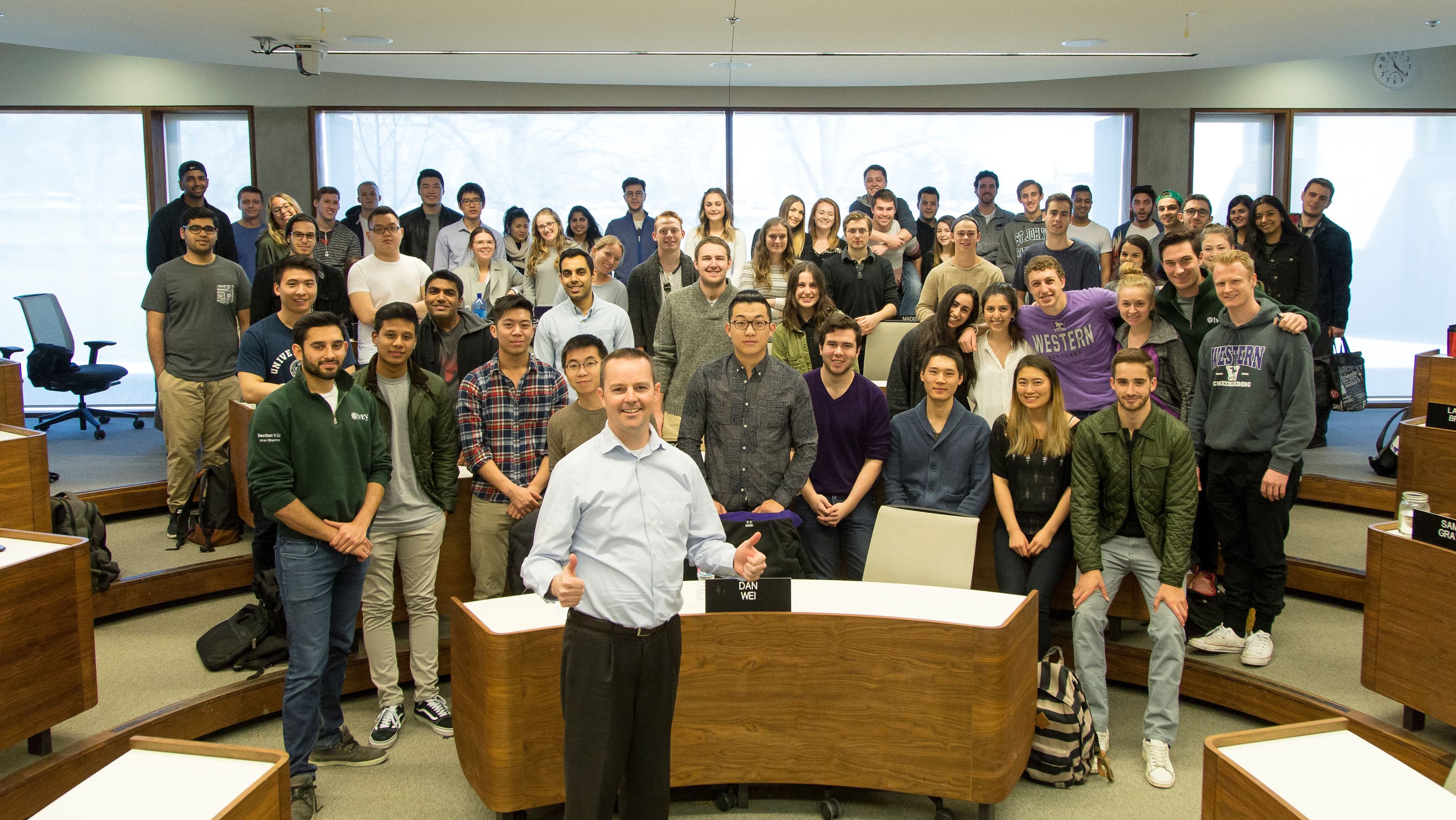
This article was written following an interview conducted with Dr. Rob Mitchell, Professor of Entrepreneurship at Colorado State University.
There’s a certain kind of Canadian idea that looks small. That is, at least until you stand next to it. The idea of Play On! Canada is one of those ideas. From a distance, it reads like a weekend might look. On the page you’d see blocked-off streets, temporary rinks, a blur of jerseys and laughter. It is a throwback to how we remember prior times. It is a remembrance of Canadian ideals, the feel-good moments that are embodied in what makes a community.
But that framing, while true, still misses something important. That is, Play On! Canada isn’t just an event. And it isn’t a business chasing profit. Instead, it is a non-profit organization that is operating in one of the toughest environments in Canadian sport, trying and doing something most institutions have quietly stopped doing. Building community at scale!
The Professor Who Took It Seriously
Dr. Rob Mitchell doesn’t romanticize things.
At least not much. He is a tenured professor of entrepreneurship and innovation at Colorado State University. He is also a former professor at the Ivey Business School, where he was enmeshed in the case method of teaching. What that means is that he loves to tell the stories of real life businesses, but as part of playing with ideas, with the goal of making them better.
When he first encountered Play On! he saw in it a story that is real.
He saw a case that students could relate to in their own experiences.
Why? Because it is real. In his words: “When I first heard about Play On! I saw an authentic story that does not sugar coat it. It is an organization that succeeded and then failed and then succeeded again and again. Sometimes we talk too much about success and contrast it with failure. In the story of Play On! we see both at the same time. And the students love it.”
While at Ivey Mitchell ended up writing three formal separate, but related, case studies on Play On! as an organization, all of which became some of the most popular taught at the school and which have since been taught all over the world. The beauty of the case is that at any given time in its history, the story challenges students to think through real-world complexity. There is not one right answer. There is not agreement. Instead, you have students wrestling with the decision-making under pressure, risk, and resilience that Play On! founder, Scott Hill, faced over and over and over.
Without a right answer, students would push on the ideas. They’d push in all directions because they related to different aspects of the story. They had questions.
· Is Hill wise to start this event?
· Is he in his right mind to keep going after failure?
· Is this really an opportunity? For him specifically?
· What would I do in his shoes?
And then in the discussion, something would shift. They would start to see what Mitchell saw. They would start to feel what Hill felt.
“The outside looking in perspective is very different from the inside looking out perspective,” Mitchell says. “And when we look from the inside, and start to realize how it might feel to act in the face of uncertainty, we start to understand how radical the idea is from the perspective of community.”
That line matters more when you remember this is a non-profit. “The question isn’t just ‘does Play On! make money?’ but is instead ‘does Play On! create value?’ and for whom? And the answer is yes, and for all of Canada. It is about connection and community.”
A Brutal Environment for a Non-Profit to Operate In
If you wanted to build a national non-profit in sport right now, you wouldn’t choose this moment. Let’s start with the obvious reasons why.
For one, Hockey Canada, long the institutional backbone and leader of the game, has spent years dealing with crisis and credibility issues. Right or wrong, trust has eroded and funding models have been strained. What this means is that at the federal level, sport sits somewhere between priority and afterthought. It’s talked about more than it’s meaningfully supported.
For another, there’s the NHL. Despite (or maybe because of) its cultural dominance, the league isn’t focused on growing Canada. It doesn’t need to. There is already a close connection. For this reason, the strategy seems to be expansion elsewhere. Even early on, when Play On! sought partnership, the NHL passed.
Those facts alone tell everything you need to know about where grassroots Canadian initiatives sit in the hierarchy. And these roots are underground, not as visible. But they are there.
And then there was the media shift. In 2014, Rogers paid $5.2 billion for NHL broadcast rights. For the street hockey organization tied to CBC, that wasn’t just a business deal, but instead reshaped the ecosystem. CBC lost hockey. Grassroots exposure shrank. Sponsor dollars chased measurable, digital returns. And corporate-owned programs began to replace independent ones
For a non-profit dependent on alignment, cities, sponsors, volunteers, that’s a seismic disruption.
Realistically, most organizations wouldn’t survive that. But Play On! did, and then it didn’t and then it did. It had to cease operations for a time, but then came back. It looks different, but it still has the same focus.
What People Miss About Play On!
The mistake is assuming Play On! is trying to behave like a traditional sports property. It isn’t.
Play On! as an organization is not optimizing for profit margins or broadcast rights.
Instead, it is optimizing for something harder to achieve, harder to measure and, increasingly, harder to find. Mitchell saw this clearly. “The need that Play On! addresses didn’t disappear. If anything, the need for community and connection is probably greater now. And community sport enables this.”
That’s the engine behind the model.
Street hockey isn’t incidental to Play On’s mission of connecting people through sport! It is intentional. There is no expensive equipment. There are no elite barriers. There is no exclusion. It is just a stick, a ball, and space.
In a society where many organized sports have become expensive and inaccessible for many, that simplicity is disruptive. “Sometimes I think Play On! is not taken seriously in terms of the impact it can have on cities, provinces and the country, because the idea behind it is so simple. Even if the execution of that idea is anything but simple.”
The Non-Profit That Behaves Like a Platform
Here’s the part that confuses people. Even as a non-profit, Play On! doesn’t operate like a small community group. At scale, it has already demonstrated it can:
· Engage millions of participants and spectators
· Activate cities and provinces across the country
· Deliver economic impact through tourism and local spending
· Become the largest sports festival in Canada
That is not theory. That is its history. Which means the model has already cleared the hardest hurdle for any organization, non-profit or otherwise. It works.
So Where Does the “Risk” Come From?
From the outside, it’s easy to list the vulnerabilities associated with Play On! For one, there is the reliance on sponsorship that community events often have. There are also the complex logistics required to make it work in a country so big. Changing social behaviour drawing us to our screens is also a hurdle.
And yes, those are real. But they’re also misunderstood. Because in a non-profit context, risk isn’t just about financial return. It’s about mission viability.
And by that measure, Play On! has already proven something else that many organizations haven’t been able to prove. It can survive disruption without losing relevance.
Even after losing major media backing and funding structures, participation remained strong.
People still showed up. That’s not fragility. That’s validation.
The Board’s Perspective
This is where Rob Mitchell’s role matters most. Not only has he been teaching about Play On! for more than 15 years, he now also serves as a director on its board. He is kind of the resident historian that sees its role in the future. In this way, as a Board Director, he isn’t evaluating Play On! as a speculative investment. He’s evaluating it as a mission-driven platform with proven demand. So from that vantage point, the calculus changes. What looks like “risk” to many becomes:
· Barrier to entry (few organizations can coordinate at this level)
· Proof of resilience (it has already endured major shocks)
· Untapped upside (relevance has increased, not decreased)
In other words, the uncertainty isn’t about whether people want this. It’s about how quickly the ecosystem can catch up to support the need that it addresses. As Mitchell describes: “Play On! has been impacting lives and enabling relationships and connection for nearly two decades. But after COVID and what that did to community and connection, the need has never been greater. The kids who remarked (in the case) that Play On! is better than Christmas are now old enough to have their own children who need their local community and that authentic connection more than ever.”
The Canadian Truth at the Center of It
There’s a reason this works here. Hockey, in all its forms, is embedded in Canadian identity. But the version most people remember nostalgically isn’t the arena, it’s the street. Driveways. Cul-de-sacs. Improvised nets. That’s where the connection starts.
Play On! doesn’t manufacture that. It organizes it.
And in doing so, it restores something that’s been quietly slipping away, one click at a time.
What This Really Is
Play On! Canada is a small organization. But it doesn’t think small. It operates at the intersection of community building, cultural identity, economic impact that is grounded in cities and provinces across Canada.
It’s not trying to maximize profit. It’s trying to maximize participation, connection, and access. And it is doing this through a model that has already proven it can scale.
Final Thought
From far away, Play On! Canada looks like a risk. It is a non-profit in a broken system. It is an event model in a digital world. It is a grassroots idea in a top-down industry.
But up close, it looks different. It looks like a validated model, with persistent demand, driving a mission that matters more now than it did before.
And maybe that’s the real takeaway.
Not that Play On! is safe.
But that, in a country where community has become harder to build, it might be one of the few organizations still equipped to do it.
Which, depending on how you see it, might make it one of the smartest bets in Canadian sport.
#PlayOn